
Ethnic Office Wear: What Actually Survives a Working Day
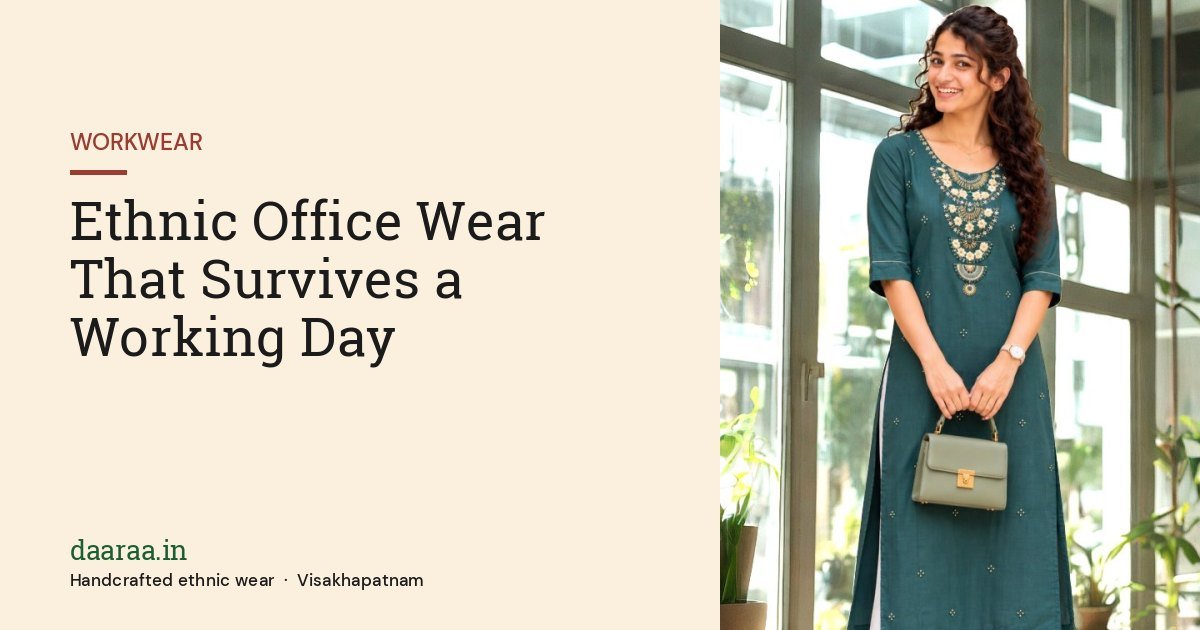
Most ethnic wear sold as office wear is just festive wear in a quieter colour. It photographs well and then spends nine hours being wrong — too warm, too stiff, too decorative for a room with fluorescent lighting and a video call at four.
What actually works is narrower than the category suggests.
Fabric first, because you are in it for nine hours
Cotton, khadi and cotton blends are the honest answer. They breathe, they take a wash every week without complaint, and they do not hold heat in an office that cannot decide on a temperature. Rayon drapes better and costs less but traps warmth; it is fine in an air-conditioned floor and miserable on a commute.
Avoid anything with a synthetic sheen. It reads as evening wear under office light, and it does not forgive a warm afternoon.
A straight kurta beats a set
A standalone straight kurta with your own trousers is more useful than a matched 3-piece. It mixes, it layers under a jacket in winter, and it does not announce itself. A full matched set with a dupatta is a lot of outfit for a Tuesday, and the dupatta will spend the day falling off your shoulder in meetings.
If you want a set, choose one where the bottom works on its own too.
Work: subtle, and in the right place
Embroidery at the yoke and cuffs is the sweet spot — it is visible when you are sitting at a desk and invisible when you are not. Heavy work across the body catches on chair arms, bag straps and seatbelts, and it does not survive a weekly wash cycle.
Small prints and fine thread work read as professional. Mirrors, sequins and beads do not, and they come off in the wash.
Fit: room to sit
Office clothes are sitting clothes. A kurta that fits beautifully standing can pull across the chest the moment you lean toward a keyboard. Go with the straight or A-line cut rather than anything fitted, and check the length — knee or just below is easiest to sit and walk in, and it works with both trousers and palazzos.
Three-quarter sleeves are the practical choice: they stay out of the way of a desk and they suit most offices year-round.
Colour: build around repeats
The point of a work wardrobe is that nobody notices it. Muted greens, slate, maroon, indigo, charcoal, dusty pinks, off-white — these repeat without being remembered, which is exactly what you want from something you wear forty times a year.
Two or three kurtas in that range, with two pairs of trousers, covers a working week more comfortably than six louder pieces.
What to look for in a listing
- Named fabric, not “premium fabric”
- A size chart in inches, with garment measurements
- Length given, not just a size letter
- A detail shot of the yoke so you can see what the work actually is
- Machine wash, or at least a stated care instruction
Our office wear kurtas are standalone straight kurtas from ₹999, with the fabric, the work and the sizes in stock listed on every page. The embroidered kurtas are the ones with yoke work; the printed pieces are the quietest of the lot.
Read next
- How to Buy a 3-Piece Kurta Set Online Without Regretting It — Fabric, fit, dupatta quality and the size-chart maths — what separates a kurta set you wear for years from one that stays in the cupboard.
- Buying Ethnic Wear Online in Visakhapatnam: A Practical Guide — How online ethnic wear actually works in Vizag — delivery times, sizing, returns, and what to check before you pay.