
What to Wear to a Haldi, Mehndi and Sangeet: A Straight Answer
Wedding season brings the same three questions every year, usually two days before the function. Here is the short version for each, and the practical detail that the Pinterest boards leave out.
Haldi
The dress code: yellow, and anything in its family — marigold, mustard, ochre, cream with yellow work. Light fabrics. Nothing heavy.
What nobody tells you: turmeric stains, permanently, and it will reach you whether or not you are the one being smeared. Do not wear your best piece. Do not wear white unless you have made peace with losing it. A cotton or light rayon kurta set you already like but would not cry over is exactly right.
Practical: haldi is usually daytime and often outdoors. You will be sitting on the floor, standing in sun, and possibly getting wet. Choose something you can move in, in a fabric that breathes. A straight kurta with a pant beats a heavy anarkali every time.
Mehndi
The dress code: green is traditional, but mehndi has loosened up more than the other two. Bright prints, floral work, orange, pink, teal — all read correctly.
What nobody tells you: your hands are out of action for hours. Whatever you wear has to go on before the mehndi and stay on after, which rules out anything with a back zip, tight sleeves you need to push up, or a dupatta that needs constant adjusting.
Practical: three-quarter sleeves, a dupatta that stays put or none at all, and a bottom you are happy sitting cross-legged in for two hours. This is the function where a co-ord set earns its place.
Sangeet
The dress code: the dressiest of the three. Jewel colours, embellishment, shine. Deep green, wine, navy, rani pink, black with gold work.
What nobody tells you: you will be dancing, and most of it is in a hall with inadequate air conditioning. Heavy fabric that photographs beautifully at 7pm is unbearable at 10pm.
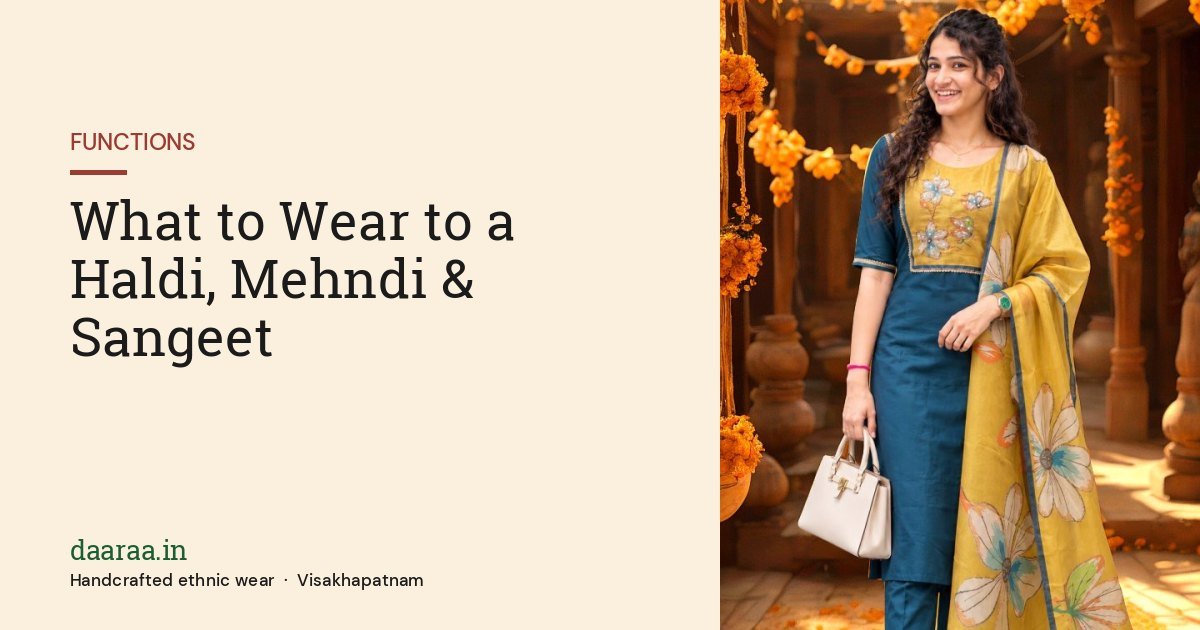
Practical: this is where embellished and embroidered 3-piece sets work hardest — a worked yoke and a good dupatta read as festive without the weight of a lehenga. Make sure the bottom lets you move; a straight pant or palazzo is safer than anything fitted.
One rule across all three
The couple’s family is in heavy traditional dress. Guests who try to match that end up either overdressed or uncomfortable, usually both. Festive but moving comfortably is the right register, and it photographs better than a stiff outfit worn awkwardly.
If you are buying for a function
Allow time. A piece ordered three days before a wedding is a gamble on courier timings and on the size being right. A week is comfortable; two is better, because it leaves room for an exchange if the fit is off.
Our festive sets are embroidered and embellished 3-piece sets for exactly these functions, and the lighter everyday kurtas and co-ord sets are what most people actually end up wearing to a haldi. Every order ships free, and exchanges run seven days from delivery.
Read next
- How to Buy a 3-Piece Kurta Set Online Without Regretting It — Fabric, fit, dupatta quality and the size-chart maths — what separates a kurta set you wear for years from one that stays in the cupboard.
- Ethnic Wear Brands in Hyderabad and Bangalore: Where People Actually Shop — The big chains, the South India labels and the small online makers — what each is good for, written by one of the small ones.